Posts

10 Gigabit Ethernet SFP + Kabel Definition, Typen & Deployment Guide
Image
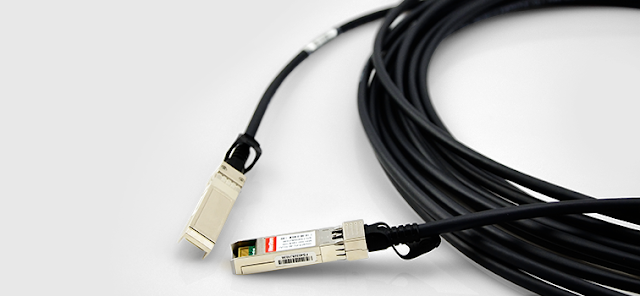
Die Netzwerkverkabelung hat im Laufe der Jahre tief greifende Änderungen durchlaufen und macht einen großen Sprung nach vorn zu hoch Geschwindigkeits Faserkabeln. Aber in einigen Fällen, Kupfer Twinax Kabel, zB SFP+ Kabel oder SFP + DAC Twinax Kabel noch als eine optimierte Lösung für 10-GbE-Anwendungen über kurze Strecken. Dieser Beitrag stellt einige grundlegende Informationen über SFP + DAC-Kabel und Überlegungen für die Bereitstellung von 10 Gigabit-Ethernet-SFP +-Kabel. SFP + Cable Basics: Definition & Typen Das SFP + DAC Twinax-Kabel ist eine Kupferverbindung mit einer Twinax-Kabelkonfektion, die direkt in das SFP +-Gehäuse integriert wird. Durch die direkte Verbindung von zwei SFP + Slots eliminiert es effektiv den kostengünstigen optischen Transceiver, der in der Ausrüstung benötigt wird, und reduziert den Stromverbrauch, die Latenz und die Installationszeit erheblich. Daher hat sich das SFP + DAC-Kabel zu einer optimalen Wahl für moderne Kurzstrecken-Hochgeschw...

Warum passives SFP+ Kabel wählen?

Image
Passive SFP+ Direct Attach Kupfer (DAC)-Kabel oder SFP+ zu SFP+ passive Kupferkabel sind 10-Gb-Kabelkonfektionen. Die Kabel entsprechen den SFF-8431-Spezifikationen und ermöglichen die Verbindung zwischen Geräten mit SFP+ -Ports. Und diese Kabel verwenden modernste Signalverarbeitungstechnologie, um den wachsenden Bedarf an kosteneffektiven Rechenzentrumsverbindungen zu decken. Warum würden Sie passives SFP+-Kabel wählen? Informationen zu passiven SFP+ -DAC-Kabeln werden in diesem Artikel angeboten. Überblick über passives SFP+ Kabel Die passive SFP+ DAC-Kabelkonfektion ist vollständig kompatibel mit dem SFF-8431 SFP+ MSA. Die Kabelkonstruktion besteht aus einem 100 zwei Paar abgeschirmten Twinax mit Ableitern für digitale Erde. Passives SFP+ Kabel ermöglicht eine serielle Datenübertragung von bis zu 12 Gbit/s in jeder Richtung. Das passive Design hat keine Signalverstärkung in der Kabelanordnung. Die elektronische Dispersionskompensation (Electronic Dispersion Compensation, EDC)...

Differences Between FBT Splitter and PLC Splitter

Image
In FTTx and PON architectures, optical splitter plays an increasingly significant role to create a variety of point-to-multipoint fiber optic networks. But do you know what is a fiber optic splitter ? In fact, a fiber optic splitter is a passive optical device that can split or separate an incident light beam into two or more light beams. Basically, there are two types of fiber splitter classified by their working principle: fused biconical taper splitter ( FBT splitter ) and planar lightwave circuit splitter ( PLC splitter ). You may have one question: what’s the difference between them and shall we use FBT or PLC splitter? What Is FBT Splitter? FBT splitter is based on a traditional technology to weld several fiber together from side of the fiber. Fibers are aligned by heating for a specific location and length. Because the fused fibers are very fragile, they are protected by a glass tube made of epoxy and silica powder. And then a stainless steel tube covers the inner glass t...

Copper SFP vs Optical SFP: Which One Is the Best to Use?

Image
The war of copper vs fiber has raged for years. Fiber seems to operate as a rival to copper rather than a replacement until now, it has already established a niche in the industry. However, with recent advances in copper technology, the copper presents the same step-ladder upgrade path. The speed difference between the two media is considerably smaller. In some ways, the copper matters most to IT experts and data center decision makers. But many end-user organizations still face tough decision about which type is the best overall value for their current and future projected needs. This battle is also being waged in SFP transceivers , there is a measurable difference in the copper SFP vs optical SFP. This article will explore their respective strengths and weaknesses and reveal insights into how IT experts are to proceed. Copper SFP vs Optical SFP: Copper SFP Is a Balanced Choice in Environment Restrictions The Gigabit RJ45 copper SFP transceiver supports 1000Mbps over Cat5 ca...

Good Forecasts for Global Optical Fiber Cable Market

Image
An optical fiber cable uses light wave for voice and data transmission, its data transmission capacity is 4.5 times more than conventional copper cables. So in the past several decades, we have seen that fiber optic cables are superior to traditional copper twisted-pair cable or coaxial cable because of its unique physical characteristics, allowing information to travel at speeds increasingly approaching the speed of light without interference between adjacent wavelengths. In leading market, the global drive to implement FTTx into more new venues is good news for the market of optical fiber cables. Another good trend is that the price erosion of optical fiber cables had been 10 to 15 percent annually, in result that the demand of optical fiber cable is expected to continue growing in the foreseeable future. And the growing data transmission workloads placed by high-performance computers, servers and network storage systems is helping spur growth in the market. Consequently, fiber opt...

A Brief Introduction of Cisco BiDi SFP Transceiver

Image
In the early stage of optical fiber communication, one optical fiber can only transmit signals of one wavelength. This is known as conventional two-fiber Bi-Directional communication - at least two fibers are needed to accomplish the full-duplex communication with TX and RX optical signals. With the development of WDM technology, transmitting and receiving of optical signals on separate wavelength can be achieved through only one single fiber. This single fiber BiDi transmission gradually becomes a popular and cost-effective solution for today’s data center and IT infrastructure, because it helps to maximize the capacity and usage of optical fibers. Consequently, BiDi optical transceiver as the basic component plays an irreplaceable role in the WDM BiDi transmission application. This article will generally introduce Cisco BiDi SFP transceivers, including GLC-BX-U, GLC-BX-D, GLC-BX-20U, GLC-BX-20D, GLC-BX40-D-I, GLC-BX40-U-I, GLC-BX80-D-I, GLC-BX80-U-I, GLC-BX120-U, GLC-BX120-D, etc. ...

SFP-GE-S-2 VS. GLC-SX-MM: What’s the Difference?

Image
SFP-GE-S-2 and GLC-SX-MM are Cisco 1000BASE-SX SFP multimode fiber transceivers. Since there are similar specifications for these two multimode modules, many end users may be confused when choosing a multimode fiber SFP LC connector SX transceiver for their Cisco switches. So, are they the same one? This post intends to give a simple explanation of SFP-GE-S-2 vs. GLC-SX-MM. SFP-GE-S-2 Module Cisco SFP-GE-S-2 is a 1 GbE SFP SX fiber transceiver that supports the maximum data rate of 1Gbps. It’s compatible with the IEEE 802.3z 1000BASE-SX standard, and can operate on standard multimode fiber optic link spans of up to 2 km. Module/Specs Cisco SFP-GE-S-2 Interface LC duplex Wavelength 1310nm Tx power -9.5 ~ -3dBm Receiver Sensitivity < -17dBm DOM Support Yes Temperature Range 32℉to 158℉ (0℃ to 70℃) Data Rat 1G Fiber Mode MMF GLC-SX-MM Module GLC-SX-MM transceiver is also a Cisco 1000BASE-SX fiber transceiver that designed for G...

SFP 40 km VS. DWDM SFP: Which to Choose?

Image
Small Form-factor Pluggable (SFP) is a compact, hot-pluggable transceiver used for both telecommunication and data communications applications. It is also called mini-GBIC for its smaller size, which is the upgraded version of GBIC transceiver. These 1Gb SFP modules are capable of supporting speeds up to 4.25 Gbps. And they are most often used for Fast Ethernet of Gigabit Ethernet applications. It interfaces a network device motherboard (for a switch, router, media converter or similar device) to a fiber optic or copper networking cable. SFP modules are commonly available in several different categories: 1000BASE-T SFP, 1000BASE-EX SFP, 1000BASE-SX SFP, 1000BASE-LX/LH SFP, 1000BASE-BX SFP, 1000BASE-ZX SFP, CWDM SFP and DWDM SFP. These modules support different distance according to the different Gigabit Ethernet standard. Today’s main subject will discuss SFP 40 km vs. DWDM SFP. SFP 40 km SFP 40 km transceiver is designed for highly reliable fiber optic network links up to...

EPON SFP VS. GPON SFP: Cost-effective Solution for Access Network

Image
With the increasing demands for higher capacity, more diversity and more personalization of services, the capacity and versatility of access networks needs to be expanded. Passive optical network (PON), as a major technology of FTTH, offers point-to-multipoint (P2MP) network access with lower installation and maintenance costs. EPON (Ethernet PON) and GPON (Gigabit PON) are popular versions of PONs at present. The related technologies keep developing and meanwhile the market of PON components keep growing. PON transceiver (EPON SFP or GPON SFP) is an essential part of PON system, in which a single fiber from a central office optical network unit (ONU) is connected to optical network terminals (ONTs) or optical network units (ONUs) at costomer premises. EPON SFP vs. GPON SFP is today’s main subject matter of this paper. Passive Optical Network (PON) Passive optical network (PON) is a form of fiber-optic access network. As the leading technology being used in FTTx (FTTH) de...

FS S1400-24T4F 24-Port PoE Switch for High-density PoE Installations

Image
Due to the increased requirements for IP surveillance networks, the appearance of PoE switches give you an easy way to add PoE devices to the network. They are ideal for small business networks that need to inexpensively use PoE to deploy wireless access points, VoIP phones and IP cameras. The PoE switch models are available with 4, 8, 16, 24 or 48 ports, although other variants are also available. 24 port PoE switch is the most prevalent variant on the market. So why your network needs a 24-port PoE switch and how can network benefit from deploying it? This article explains it in detail. Why Your Network Needs A 24-Port PoE Switch? When choosing an Ethernet switch, the most important is to check whether the numbers of ports on the switch are enough to connect all your devices. The same is true when choosing PoE switch . PoE ports are flexible to connect with Cat5e cable without additional settings. Generally, the PoE switch has the uplink ports, which allow long distance...

10G DWDM Tunable XFP - Up to 80 km Reach

Image
With the spread of cloud computing and mobile broadband service, the volume of communications traffic has rapidly increased. In order to enable high-capacity optical networks, using a single optical fiber for optical signals of several different wavelengths in DWDM system is widely used. For this reason, tunable transceiver that enables ROADM functionality in next-generation networks is becoming more and more popular. In today’s market, there are mainly two kinds of tunable DWDM transceivers: tunable XFP and tunable SFP+. This article will take you to explore the DWDM C-band tunable XFP transceiver with 40 / 80 km transmission distance options. Tunable XFP Transceiver Tunable XFP transceiver is an integrated fiber optic transceiver that provides a high-speed serial link at signaling rates from 9.95 Gbps to 11.35 Gbps. It complies with the ITU-T G.698.1 S-D100S1-2D standard with 50GHz channel spacing for SONET/SDH, IEEE DWDM 10GBASE-ZR for 40 or 80 km reach (Ethernet), and DW...